Let America Be American Again Analysis
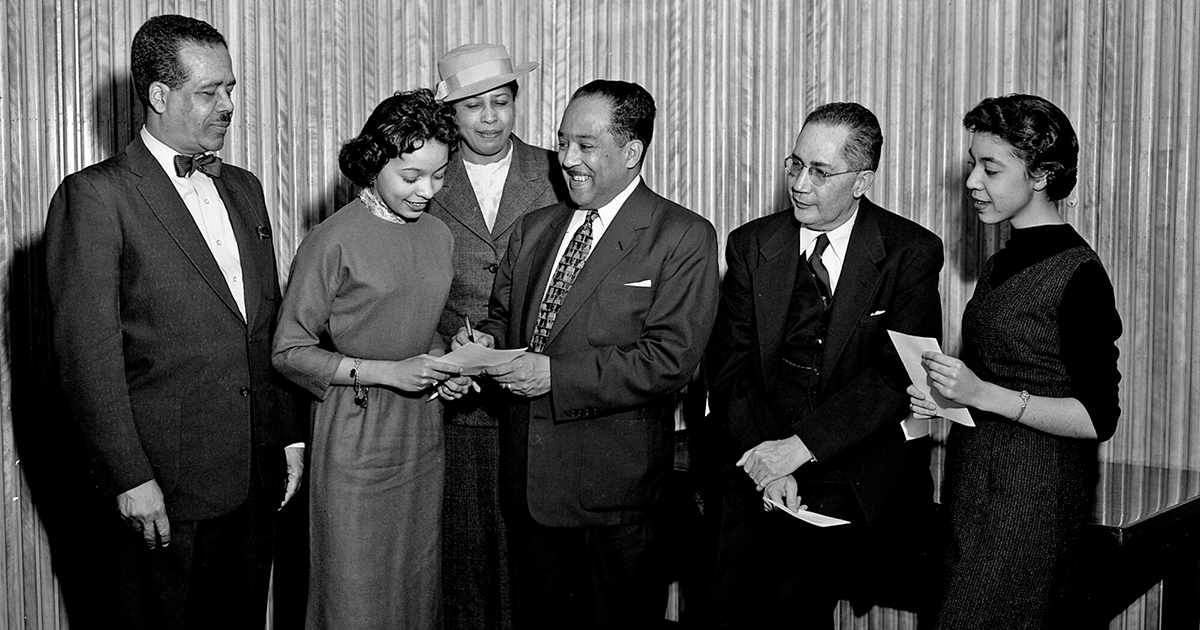
Langston Hughes signs autographs following a lecture at Howard Academy in 1957 (Washington Area Spark/Flickr)
Following Donald Trump's ballot, a poem by Langston Hughes started trending on social media and, in the aftermath of the decease of George Floyd and others in law custody, the poem has constitute new urgency. Mayhap information technology was the word again that first drew people's attention. Decades before Trump used the word in his 2016 campaign slogan to "Brand America Bang-up Again," Hughes published a verse form called "Let America Exist America Once more."
Sometimes referred to every bit the "poet laureate of Harlem," Hughes was born in 1902 in Joplin, Missouri, and raised in the Midwest. After living in United mexican states for a twelvemonth, he arrived in New York in 1921 to written report engineering at Columbia University. Drawn to the literary life, he joined other voices at the forefront of the Harlem Renaissance, writers such equally Alain Locke, Zora Neale Hurston, James Weldon Johnson, Claude McKay, and Arna Bontemps. Hughes's first poem, "The Negro Speaks of Rivers," published in 1921, addressed the Black feel in America: "My soul has grown deep like the rivers."
Hughes left Columbia and traveled to the due west coast of Africa, Rotterdam, Paris, and northern Italia, returning to the United States in 1924. In 1926, he published his first book of poems, The Weary Dejection. Influenced by poets such as Walt Whitman, Carl Sandburg, and Paul Laurence Dunbar, Hughes embraced gratis verse. His collection included the poem "I, Too," which opens "I, too, sing America," and closes "I, too, am America." ("I hear America singing," his spiritual mentor Whitman had written.)
In 1929, Hughes graduated from Lincoln University, the nation'southward first caste-granting historically Black college. He continued to travel widely and, through the 1930s, wrote poems, plays, brusk stories, and a novel. He was sympathetic to radical causes, and his piece of work across the decade displayed a socialist rhetoric mutual to the era. Simply he never joined the Communist Party, as many of his friends may have.
Hughes published "Allow America Exist America Again" in an abbreviated version in 1936 and in its last grade 2 years later in A New Song, a collection issued by the International Workers Club. The piece of work addresses the pregnant of America and offers both a critique and an affirmation of the American ideal.
Lamenting the conditions of the Depression, with millions unemployed, the verse form asks what happened to America, the purported "homeland of the free."
Information technology begins "Let America be America again / Let it be the dream information technology used to be," then continues, "Let America be the dream the dreamers dreamed." It's a dream of freedom, equality, opportunity, and liberty—the ideals that form the bedrock of the nation. All the same a parenthetic phonation adds, "(America never was America to me)."
If you know Hughes'southward work, information technology is tempting to read the parenthetic "me" as a victim of the long history of racial segregation and oppression. The poem anticipates this supposition, and a new vocalization asks, "Say, who are yous that mumbles in the nighttime?" What follows is a list of everyday Americans: "the poor white," "the Negro," "the red homo," "the immigrant," "the farmer," "the worker." All are carrying hope for a better future, and all take fallen victim to "the aforementioned onetime stupid plan / Of dog eat canis familiaris, of mighty crush the weak." America is not America to any of them.
Given Hughes's radical sympathies, the form analysis is not surprising. The poem laments the conditions of the Low, with millions unemployed and on relief, and asks what happened to America, the purported "homeland of the free," where so many accept nil left now "except the dream that's almost dead today."
Nigh dead, however unvanquished.
For Hughes, the Usa was an unrealized, perhaps unrealizable ideal. Information technology was a land that "never has been yet— / And yet must be," a dreamland unlike any other country. Only the nation'due south failure time and again to alive up to its aspirations is a profound part of the story. Whatsoever its struggles, the United States has always identified itself by its dreams. Dreams inspired by abstractions similar democracy, justice, and rights. Dreams animated past those seeking freedom and equality. Dreams stirred past those making a new home in America and pursuing a ameliorate life. Hughes believed in those dreams, and his poem ends non with despair, only with an urgent plea:
Nosotros, the people, must redeem
The land, the mines, the plants, the rivers.
The mountains and the endless apparently—
All, all the stretch of these great greenish states—
And make America again!
Hughes would continue to recall about America, asking, "What happens to a dream deferred?" in a 1951 poem titled "Harlem." Martin Luther King Jr. had also been contemplating dreams, long before his "I Take a Dream" speech at the Lincoln Memorial. Rex and Hughes were friends: in 1956, King recited a Hughes poem, "Female parent to Son," from the pulpit. Because of the poet's suspected Communist sympathies (Hughes had testified earlier Joseph McCarthy's Senate Permanent Subcommittee on Investigations), however, King publicly kept his altitude. Nevertheless, in 1967, seven months later Hughes died, he alleged that although "I am personally the victim of deferred dreams, of blasted hopes … I nevertheless take a dream."
King must have appreciated the closing of "Let America Be America Again," where the people are summoned to redeem the state. In a sermon first delivered in 1954, he alleged that "instead of making history, we are made by history."
The line is easily misunderstood. King was not offering an argument for why history matters; rather, he was decrying passivity and insisting on empowerment. It was a call to action. The preacher was telling his congregation that the time for waiting on dreams was over—the fourth dimension for making dreams come up truthful had begun.
Source: https://theamericanscholar.org/let-america-be-america-again/
0 Response to "Let America Be American Again Analysis"
Post a Comment