Do Any People Exonerated Commit Crimes Again
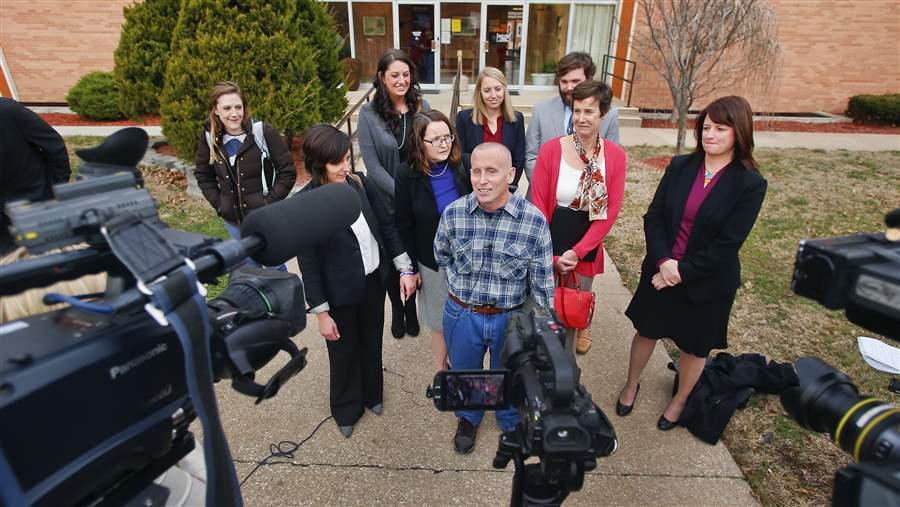
Floyd Bledsoe, center, after walking out of the Oskaloosa, Kansas, courthouse a complimentary human being in Dec 2015, after new evidence showed he was wrongly convicted of murder in 2000. Many states, including Kansas, are trying to figure out what people similar Bledsoe are owed for the fourth dimension they spent backside bars.
© Chris Neal/The Topeka Capital-Periodical via The Associated Press
In April 2000, 23-yr-sometime Floyd Bledsoe sat in an Oskaloosa, Kansas, courtroom awaiting the verdict in his beginning-degree murder trial in the decease of his 14-year-erstwhile sister-in-constabulary, Zetta "Camille" Arfmann. Throughout the trial, he maintained his innocence. Just the jury entered the courtroom and declared him guilty.
Bledsoe was sentenced to life in prison plus 16 years, but doubts well-nigh his interest in the murder lingered. The criminal offense scene yielded petty concrete bear witness, and Bledsoe'southward brother, Tom, 25, had originally confessed to the murder before recanting and pinning the crime on Floyd.
After years of fruitless court challenges, Bledsoe was vindicated in a gut-wrenching twist: In 2015, Tom Bledsoe confessed to the murder in a suicide note before asphyxiating himself. Within a calendar month, a guess vacated Bledsoe'southward conviction and he was released from prison house. The twenty-four hours of his release, Bledsoe recalls, was a mixture of commemoration and mourning.
"Earlier I was locked up, I had xl acres, livestock, a married woman and kids," he said. "When I was released, I had zippo … I lost my family unit, my job, my reputation — everything."
Bledsoe found piddling support as he adjusted to life exterior of prison, including from the state that locked him upwardly for more than xv years. A bill earlier the Kansas Legislature would brand up for part of that past making him eligible for $lxxx,000 for each year he spent behind bars.
A steady increase in exonerations in recent years, frequently a issue of new Deoxyribonucleic acid-testing capability, has prompted lawmakers in states like Kansas to consider legislation that guarantees compensation for those who are wrongfully convicted and imprisoned. And in the 32 states that have bounty laws, some lawmakers have sought to increase the amount of bounty exonerated individuals would receive, expand the eligibility for compensation or streamline the process for getting it.
It's only merely that states provide compensation to people who are wrongly convicted and imprisoned, advocates for the wrongly convicted say.
"When an innocent person is deprived of freedom because of a wrongful confidence, regardless of error, the government has a responsibility to exercise all it can to foster that person's re-entry in order to help restore some sense of justice," said Maddy deLone, executive manager of the Innocence Project, a nonprofit legal arrangement that specializes in wrongful conviction cases. "Fair compensation is part of that."
According to the National Registry of Exonerations, 2,000 wrongfully convicted individuals have been exonerated for state and federal crimes since 1989. In 2016, in that location were 166 exonerations nationwide — the nearly since the registry was established near 30 years ago.
In 2004, Congress passed the Justice for All Deed with bipartisan support. The police force guarantees individuals exonerated of federal crimes $l,000 for every year spent in prison house and $100,000 for every year spent on death row.
From state to state, however, those who are exonerated are not guaranteed the same rights or compensation later on a conviction is overturned. "It actually matters where yous're convicted," said Amol Sinha, land policy advocate at the Innocence Projection.
In Texas, a state known for its tough-on-crime posture, the exonerated are paid $80,000 for every year spent in prison house and are eligible for monthly annuity payments after release. The country's generous compensation law has added up over time. In the final 25 years, Texas has paid over $93 one thousand thousand to wrongfully convicted individuals.
Wisconsin, on the other hand, pays $5,000 for every year spent in prison house, capped at a maximum of $25,000. Some states offer in-kind benefits in addition to budgetary compensation. Vermont, for example, provides wellness care coverage for 10 years after an exonerated individual is released from prison house.
In states without compensation laws, like Kansas, those who are exonerated typically take to file a lawsuit to go compensation or convince legislatures to pass a special appropriation to pay them. Lawsuits can be fourth dimension-consuming, plush and challenging to win. And winning compensation from a legislature isn't guaranteed.
In Kansas, for instance, a wrongfully bedevilled person currently must go to the Legislature's Special Claims Confronting the State Committee and plead for compensation.
Debate Over Amounts
How much people deserve for the time they lost behind bars often is in dispute. Information technology was in Indiana this year.
Rep. Greg Steuerwald's pecker would compensate individuals with $25,000 for every twelvemonth of wrongful incarceration. Democratic Rep. Greg Porter thinks they should receive $35,000 for every year of imprisonment.
Both bills would honor compensation only to people whose crimes were vacated through Dna assay. The attorney general would exist in charge of processing claims for wrongful confidence bounty, and neither bill would use retroactively. Just both bills appear expressionless for the yr.
Frances Lee Watson, founder of the Wrongful Conviction Clinic at the Indiana University McKinney Schoolhouse of Law, said she hopes legislators will continue to push for compensation. "Convictions are nevertheless being vacated and people are still beingness exonerated in Indiana — just we don't have a compensation law," she said.
Some other sticking point in trying to pass bounty laws is overcoming lawmakers' general faith in the criminal justice system or disarming them that innocent people tin can exist convicted.
In nearby Michigan, Republican Gov. Rick Snyder signed a beak in December that pays $l,000 for each twelvemonth of wrongful imprisonment and provides re-entry services after release. But the bill's sponsor, Democratic Sen. Steve Bieda, first introduced information technology in 2004.
"I call up [legislators] had a hard time wrapping their heads effectually the fact that someone could spend so much time behind bars and non have done something incorrect," Bieda said of his struggle to pass the neb. "I had to reintroduce [the legislation] again and again."
Lawmakers in other states are looking to tweak their compensation laws by streamlining payments or ensuring that some people aren't left out unfairly.
In Tennessee, for example, Republican Rep. Mark Pody wants to make it easier for people who are innocent, but aren't exonerated by the state's parole board or the governor, to receive compensation. Why? A judge vacating a confidence is not enough for an private to qualify for bounty under current law.
His neb would allow a wrongfully bedevilled individual to utilise for bounty without an official exoneration afterward spending at least 25 years in prison and if the confidence was overturned past Dna testify.
The neb wouldn't touch many people in Tennessee. Merely it would affect Lawrence McKinney, who was released from prison in July 2009 afterward 31 years based on new Deoxyribonucleic acid testify. McKinney was denied an official exoneration from the parole lath and is currently pending a decision from Republican Gov. Bill Haslam.
Compensation in Kansas
After spending time on the Kansas Legislature's joint commission that decides on civil claims for wrongful conviction, Autonomous Sen. David Haley decided he wanted to alter how innocent people such as Floyd Bledsoe are compensated in his land to make it more simply and evenhanded.
"Some [people] fabricated compelling arguments," he said, "merely at that place seemed to be no rhyme or reason as to who [was awarded] what."
So last month, he introduced a pecker that would recoup wrongfully convicted individuals with $80,000 for each year spent in prison house or $1 meg if sentenced to decease. It would likewise pay $5 1000000 to the heir of an individual who was wrongfully executed, though the state hasn't conducted an execution since 1965.
The nib hasn't passed yet. There are questions nearly whether $80,000 is the right amount. And the bill has been amended to include some notable limitations: Individuals who pleaded guilty or no contest to a offense, for example, would not exist eligible for bounty — even if the conviction was afterward vacated.
Sinha of the Innocence Project said provisions like this in compensation laws can deprive some innocent people of their rightful compensation because they were coerced, or saw trivial hope in winning at trial and agreed to a plea bargain.
The National Registry of Exonerations has confirmed over 350 instances of individuals who pleaded guilty to crimes they did not commit. According to the Innocence Project, nearly xi percentage of the nation'southward Deoxyribonucleic acid exonerations involved innocent people pleading guilty.
Haley'southward neb in Kansas too would require people who are exonerated to use for compensation within two years subsequently their release from prison. That would exclude the bulk of people whose convictions have been vacated.
Bledsoe, whose brother committed the murder he spent time in prison for, doesn't desire to be ane of those people. Only time is running out for him to go the level of compensation Haley thinks he deserves. Dec. viii will marking two years since his release from prison.
"I haven't completely lost faith in our justice system," Bledsoe said. "[But] it's difficult to trust in something that'southward not perfect."
Source: https://www.pewtrusts.org/research-and-analysis/blogs/stateline/2017/03/14/what-do-states-owe-people-who-are-wrongfully-convicted
0 Response to "Do Any People Exonerated Commit Crimes Again"
Post a Comment